Two Is the Magic Number – Two Skills Per Week
August 22, 2025
By Teach to One

Why We Recommend Two Skills Per Week in Teach to One Roadmaps
We’ve all heard that Three is the Magic Number, but for Teach to One Roadmaps, the magic number is two. Two skills per week is the optimal pace for helping students make meaningful, sustained progress in math.
Here’s why.
Why Two Skills Works
When students move too slowly, with, for example, one skill a week, they risk ending the year still far from grade level. Two skills per week works because it’s achievable.
Our classroom observations and research show that two skills per week strikes the right balance:
 It’s achievable. A skill includes procedural, conceptual, and applied understanding, and is something students can typically learn in 1–3 sessions of 30–40 minutes each, then show mastery on a short, formative assessment (we call it a Skill Challenge).
 It adds up. If a student begins the year having mastered 42 of the 119 skills they need, one skill a week would get them to about 72 skills—below the mastery threshold. Two skills a week gets them to roughly 102 skills, or mastery of 82% of the skills they need for grade level. Research shows students who reach mastery of 70%+ of their grade level skills are far more likely to test at or above grade level on state tests.
 It delivers results. It’s a tangible target that keeps students motivated and, more importantly, it aligns with the level of progress that past Roadmaps students have needed to reach proficiency on their state assessments.
Recent research confirms just how powerful a personalized, skills-based roadmap can be:
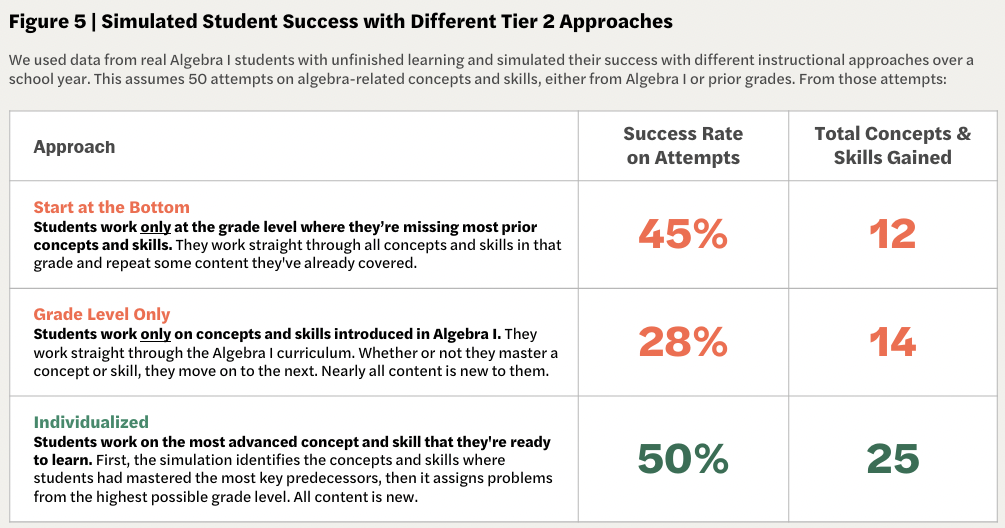
- Research—including Unlocking Algebra: What the Data Tells Us About Helping Students Catch Up from TNTP—shows that this pace significantly increases their chances of being proficient. For example, TNTP found that students who completed just 30–40% of their roadmap were unlikely to pass their state exam. By contrast, students who reached 70–80% completion—a typical outcome for those averaging two skills per week—moves them from a place where nearly every student fails the state exam into a range where 75% of students reach proficiency.
- Readiness is determined by how many of the key predecessor skills a student has mastered for a target skill. In its report Unlocking Algebra, TNTP found that in math instruction “[w]hen an individualized approach responded to students’ existing mastery of key predecessors … students learned nearly twice as much over the course of a year” as compared to a start-at-the-bottom or grade-level only approach.
- An independent study by ACS Ventures found students’ progress in Teach to One Roadmaps is highly correlated with state assessment scores, and strongly predicts performance across different grade levels and skill domains. Critically, every study participant who mastered all their assigned skills scored proficient or above on their state test.
- This case study shows that students using Teach to One Roadmaps grew an extra 5.6 RIT points on MAP assessments, equivalent to one and a half semesters of learning, compared to matched peers
These findings demonstrate that a well-paced, readiness-based approach (like two skills per week) isn’t just convenient, it measurably boosts proficiency.
How Teach to One Roadmaps Makes It Possible
Traditional pacing often follows a grade-level calendar, which can leave some students lost and others bored. Teach to One Roadmaps redefines the model as students move forward based on readiness, not the date on the calendar.
Every student starts with a diagnostic that pinpoints exactly which skills they have (and haven’t) mastered. Teach to One Roadmaps then recommends the next best skill each student is ready to learn, so time is spent where it counts most.
Strategies to Hit Two Skills Per Week
Once teachers know exactly which skills each student is ready for—based on actual data rather than assumptions—they have the “right insight” to guide instruction. The next step is putting it into action. That’s where simple, practical, teacher-tested routines can make this goal realistic for any classroom:
Keep motivation high
- Use incentives like a Skill-o-Meter, leaderboard, or our weekly “2 Skills Tuesday” celebration.
- Have students set personal skill goals and track their own progress.
- Use Teach to One Roadmaps Skill Challenges as exit tickets to reinforce learning.
- Assign personalized homework to keep momentum going when class time is short.
Build structure and consistency
- Hold small-group meetings twice a month for targeted support to help students catch up or push ahead.
- Monthly one-on-one check-ins let teachers celebrate progress and troubleshoot readiness barriers.
- Make Teach to One Roadmaps time a predictable part of your weekly rhythm.
- Use visual progress boards to keep goals front and center.
Overcome common challenges
- Time constraints: Look for spots where Teach to One Roadmaps can replace existing activities like exit tickets or certain homework blocks.
- Grade-level mandates: Show leaders how Teach to One Roadmaps connects directly to core and intervention work.
- Readiness concerns: Remember, Teach to One Roadmaps only recommends skills students are ready for.
- Engagement dips: Lean on your classroom culture, incentives, and visible progress tracking.
For more suggestions and resources, see the article Motivation, Goals, and Pace on the Roadmaps Resource Center.
The Bottom Line
Two skills per week isn’t just a nice-to-have—it’s a readiness-informed pace that builds both confidence and competence. With the right routines, students can hit that target, stay motivated, and make the kind of progress that truly changes their math story.
Latest Posts

My Seven Bosses and their Sixth-Grade Teacher
Our Research and Development team working on Teach to One Roadmaps at New Classrooms has had, admittedly, some crazy ideas. I tend to get a lot of latitude, but I’ve recently been subjected to weekly performance reviews where I’m told, multiple times, that my work isn’t good enough.

Building a Culture of Engagement Through Student Agency
Our middle school in the Bronx is always striving to be a place where students can take ownership of their own learning. Often in education, words such as “engagement” and “agency” are just overused buzzwords—but at the South Bronx Early College Academy (SBECA), we believe this mindset is crucial for adolescent learning.
Data-Informed Instruction: A Formula for Success
In my classroom, kids don’t need more work—they need the right work. By using quick formative assessments like exit slips at the end of each class, I gather real-time data to guide flexible, responsive grouping for the following week. It’s all about solving for what students need, not just assigning pages from the book.
